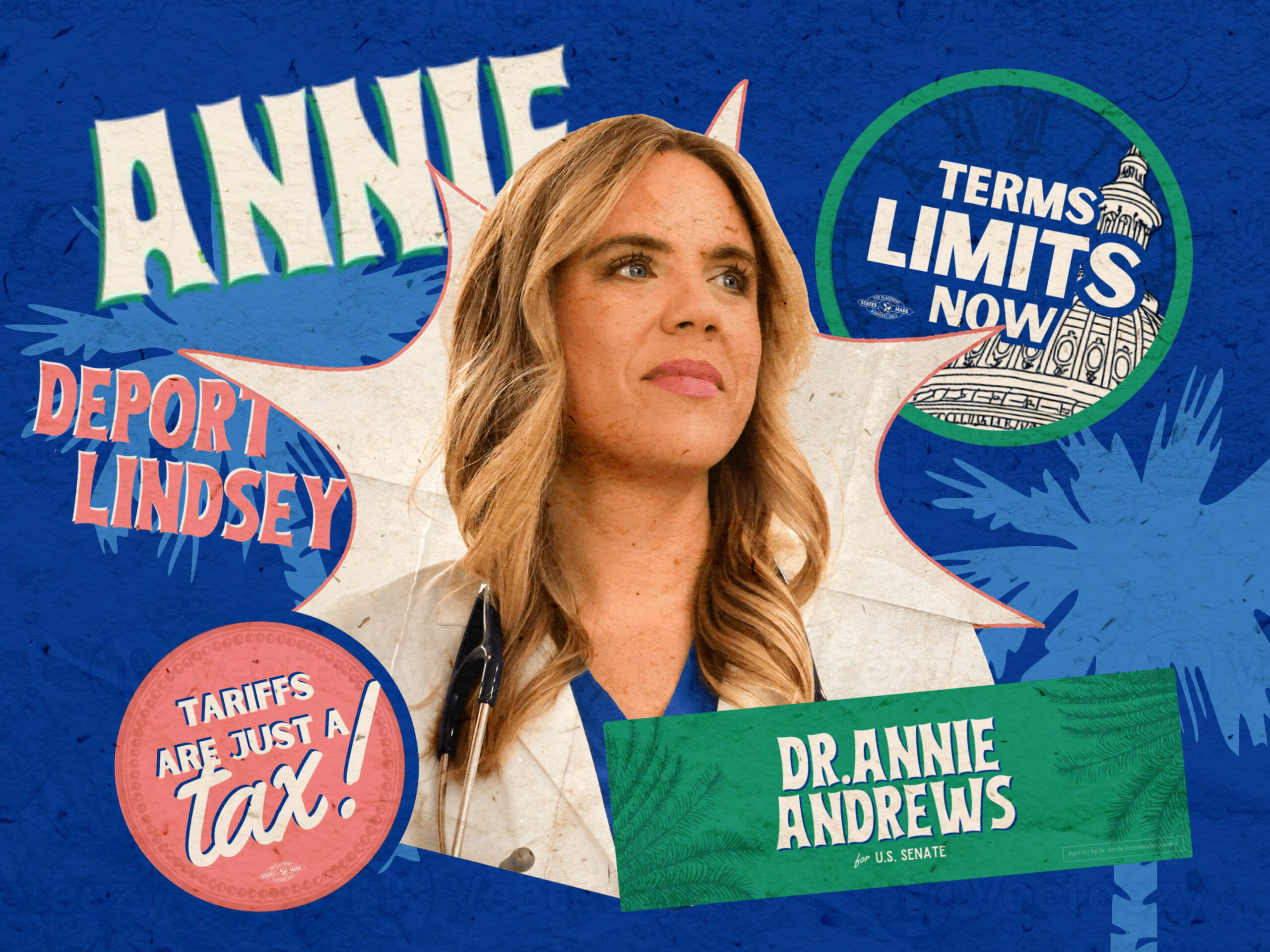
South Carolina hasn’t sent a Democrat to the U.S. Senate since 1998. That number hangs over everything Dr. Annie Andrews does this year, and she knows it. She’s a Charleston pediatrician, a mother of three, and a second-time candidate asking voters to believe that nearly 24 years of Lindsey Graham is enough. It’s a longer shot than most campaigns admit out loud. It’s also not the complete fantasy it would have been a decade ago.
A Doctor’s Case Against the Status Quo
Andrews is running on the issues she saw firsthand as a pediatrician. For nearly 20 years, she treated children and worked with families across South Carolina. She talks often about high healthcare costs, insurance problems, rural hospitals closing and the lack of maternal care in some parts of the state.
Those issues are personal to her because she has seen how they affect families. Instead of talking about healthcare only as a political issue, Andrews talks about what happens when parents cannot afford appointments, when insurance will not cover care or when the closest hospital is far away. That gives her a different kind of message than most candidates.
The Incumbent’s Advantage

Money is one of the biggest differences between Andrews and Graham.
Graham has been in the Senate for nearly 24 years, so he has built strong connections with major donors, PACs and national political groups. He also has a large amount of support from groups connected to the pro-Israel movement.
Her argument is that Graham’s campaign is supported by people and groups far outside South Carolina, while many regular South Carolina families are worried about things like doctor bills, insurance costs and making time for appointments.
Andrews has taken a different approach. Her campaign relies more on small donations, volunteers and social media. She posts short videos about healthcare, parenting and Graham’s record in office. That has helped her reach younger voters and people who probably would not pay attention to a normal political ad.
Still, social media attention is not the same thing as winning votes. Graham has much more money, more name recognition and support from major Republican leaders. He has been endorsed by Donald Trump, Gov. Henry McMaster and Sen. Tim Scott.
Andrews also has to deal with recent history. In 2020, Democrat Jaime Harrison raised a huge amount of money and got national attention, but Graham still won by about 10 points. That shows how difficult it is for any Democrat to win a statewide race in South Carolina.
The Cost of War
Graham has spent years arguing the U.S. should be more aggressive toward Iran. In 2025, he pushed for the United States to support military action against Iran’s nuclear program, saying diplomacy was unlikely to work.
His position on Gaza is similar. As Palestinians have been killed, displaced and cut off from food, medicine and safe shelter, Graham has continued to support escalation. Last year, he said Israel may need to take Gaza “by force,” comparing it to the United States’ campaigns in Tokyo and Berlin during World War II.
Hamas’ Oct. 7 attack was horrific. However, that does not mean every military response should automatically be supported, especially when innocent civilians usually are the ones paying the price. Graham has dismissed calls for restraint, even as more people in Gaza have been killed or driven from their homes.

That matters in a Senate race. Graham can call it being tough on terrorism. But voters should also ask whether he is too quick to support military action, even when it leads to more destruction and no real path toward peace.
What It Would Take to Win
For Andrews to have a real chance, she will need more than Democratic voters. She will need independents and some Republicans who are starting to question whether Graham has been in Washington too long.
A lot of voters may still like Graham personally. But after 24 years in the Senate, it is fair to ask whether he is more focused on party leaders and big donors than on the people in South Carolina he is supposed to represent. That is where Andrews may have an opening.
An Uphill Race
Andrews is still the underdog. Graham has more money, more experience and a much stronger political network across the state. South Carolina has also been a hard place for Democrats to win statewide races.
But Dr. Andrews has an argument that could connect with people. Healthcare is expensive, rural hospitals are struggling, and many families feel like they are being ignored by politicians in Washington. Andrews has worked with those families for years, and that gives her something real to campaign on.
After 24 years in the Senate, Graham’s record is clear. So is Andrews’. Voters now get to decide which one they think South Carolina needs.